
Artist statement

Beyond the Screen: Digital Image as Cultural Montage and Epistemic Interface

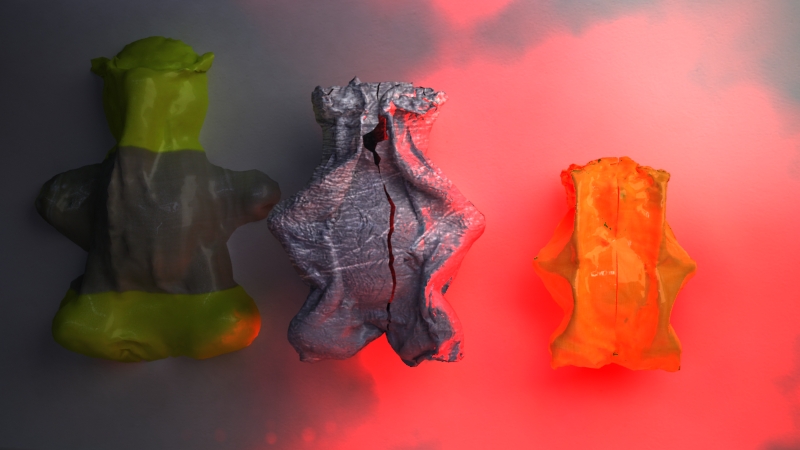
The fundamental starting point of my artistic practice is located on what I refer to as the other side of the screen, within the realm of media simulacra. This is a space where the boundaries between reality, representation, and its algorithmic simulation begin to dissolve. I understand this space as fluid and constantly shifting, a terrain where new modalities of image, meaning, and identity take form.Since around 2022, I have focused on the creation of 3D digital objects that can be understood as speculative simulants of socio-cultural phenomena. These digital artifacts are not illustrations of reality but parallel reflections. They form a type of parareality, constructed through digital media, online algorithms, and the aesthetics of internet marketing.

At the core of my methodology is the analysis of social moods and discourses present within the networked ecosystem. These moods, gathered through search engines and data platforms, have served as generative proto-prompts for the construction of visual structures. The data I collect are not simply raw material. They function as epistemic interfaces through which the architecture of the digital image emerges. The image does not passively carry meaning; it acts as an active element in the discourse on what is perceived as relevant, urgent, or socially sensitive.

The resulting works usually engage with contemporary social questions and their complex interrelations. They take the form of visual analysis and develop critical perspectives within global virtual structures. Topics such as political polarization, the digitalization of memory, the mediatization of violence, or the virtualization of intimacy do not appear as direct illustrations. Instead, they are configured as visual algorithms that articulate the logic, structure, and latent symbolism of late-capitalist visual culture.In this context, my artistic strategies move between the digital ready-made, artistic research, and semiotic critique. The artwork is approached as a processual structure that emerges through the transposition of data, social signs, and digital emotion into visual form. It is not the outcome of a traditional creative gesture but the result of cultural montage, in which the algorithm becomes a co-author of meaning.

One of the central threads in my work is the analysis of sexual, social, and religious pressure exerted on the individual under the conditions of digital late modernity. These pressures often do not manifest overtly but appear in invisible structures of visibility. They are present in what is shown, hidden, aestheticized, or suppressed. I understand these forces as symptoms of collective anxiety that take shape through images, media architectures, and the cultural protocols of algorithmic exposure.

For me, 3D digital media or what I call superreality offer a natural environment for integrating immaterial forms of aesthetics. These include data flow, digital emotionality, and algorithmic association. Within such media, I find the most effective way to construct virtual images that operate less as representations and more as conceptual structures. The use of digital methods itself is not merely an aesthetic decision. It is a critical gesture embedded in the method of production.My approach can be compared to Roland Barthes’s observation that “the text is a tissue of quotations drawn from the innumerable centers of culture.” In a similar sense, the digital image becomes a tissue woven from data, algorithms, and cultural signals. In my work, images are composed through fragments. This is not collage in the traditional sense, but an architectural construction shaped by overlapping themes, references, and data flows.

The formal strategies of this construction are shaped not only by thematic focus but also by the use of data analysis and AI-based techniques. These techniques draw inspiration from the structures of internet marketing. They allow hidden or suppressed connections to surface, ones that would otherwise remain invisible. The visual systems I construct are regularly checked against the context of global search engines, which offer both feedback and a form of distributed curatorial framing.The title of each work, as well as the objects it presents, are part of a semantic network created through a process that fuses research with production. Each project takes shape as a 3D digital composition, one that might resemble a child’s puzzle. It is deceptively simple but deliberately fragmented so that the viewer is drawn into the act of completion.

A key step in my process is the public testing of concepts already during their early development. By publishing previews on blogs and social media, I evaluate visual feedback, emotional response, and interpretive possibilities. I treat these platforms not only as channels for distribution but as experimental grounds for intermedial exploration. By using these strategies, I do not merely borrow the raw visuality of advertising. I also adopt its structure, dynamics, and rhetorical mechanisms. In the end, the resulting work is both an artwork and a marketing project. However, in this context, marketing does not mean commerce. It refers to a method of orchestrating visibility within the conditions of contemporary media culture.